How Do You Write a Successful Resume for a Full Stack Developer in 2026?
Checkout ATS compliant resume template for this role and our vast repository of resume templates.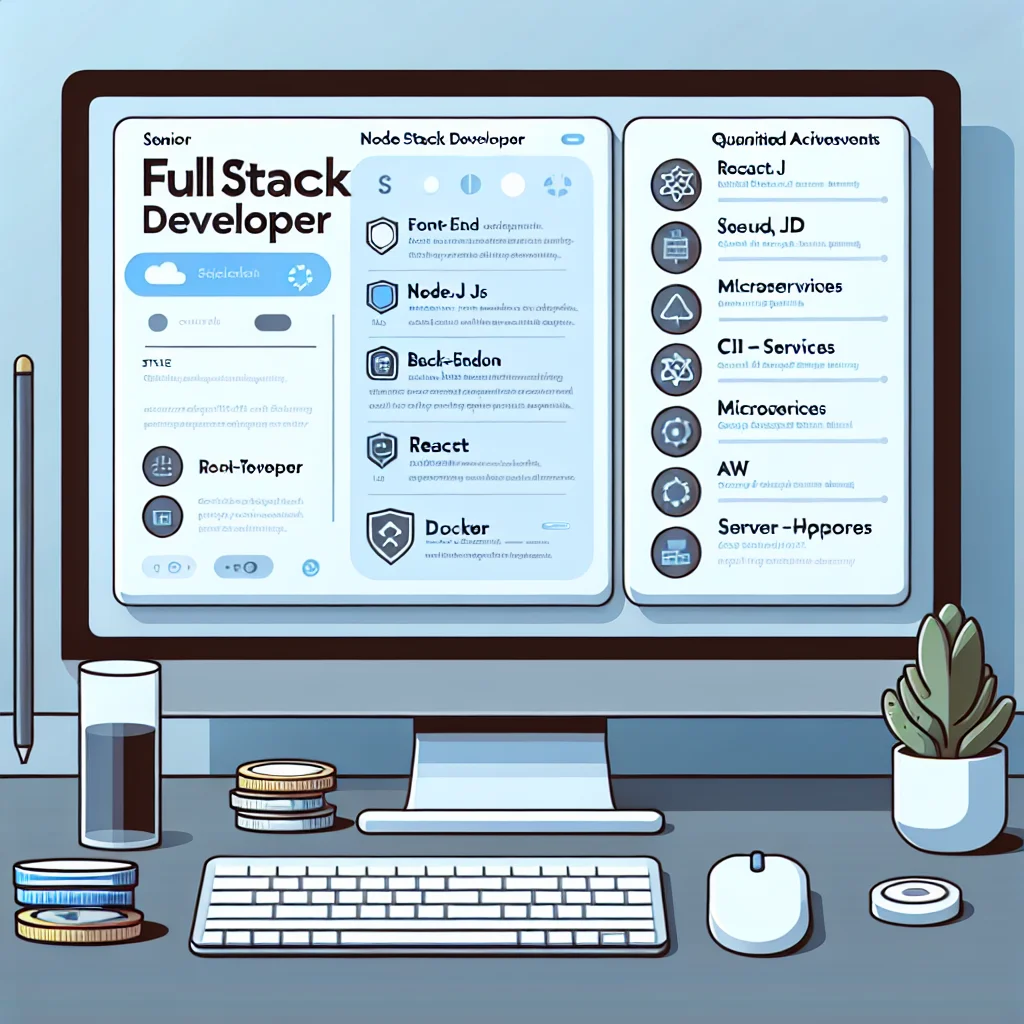
If you’re hunting for a full stack developer job, your resume is your first impression. Recruiters skim hundreds of pages in minutes. A clean, metric-driven resume helps them see your value fast. This guide shares practical steps, ready-to-use headlines, and concrete examples to elevate your resume for this in-demand role.
You’ll see tips that work across junior to senior levels. You’ll also find ideas to highlight recent trends like cloud skills, API integrations, and AI-assisted features. Use these ideas to tailor your resume for each job description. The goal is clarity, relevance, and measurable impact.
Check Your ATS Score
See how well your resume performs against Applicant Tracking Systems
Top 10 Resume Headlines for Full Stack Developers
A strong headline sets the tone. It tells the recruiter your level, focus, and the value you bring. Use these headline templates as a starting point and customize for each role.
- Entry-Level Full Stack Developer | React & Node.js Enthusiast
- Mid-Level Full Stack Engineer | MERN Stack | Cloud & CI/CD Ready
- Senior Full Stack Developer | 10+ Years Building Scalable SaaS
- Full Stack Developer | API Design, Microservices, Performance Tuning
- Full Stack Engineer | Frontend-Driven UX with Node.js Backend
- Full Stack Specialist | AWS, Docker, and Modern Web Apps
- Software Engineer (Full Stack) | Data-Driven UI & API Excellence
- Cloud-Focused Full Stack Developer | Serverless & Microservices
- Senior Full Stack Engineer | Lead Projects from Idea to Deployment
- Versatile Full Stack Developer | Python/JS Stack for Rapid MVPs
Tip: Mix in a line about impact when possible, like “reducing latency by 40%” or “cutting deployment time in half.” Keep headlines under 12 words for readability. For remote roles, add “remote” or “distributed team” if relevant.
Crafting a Standout Profile Summary Section
The profile or summary is where you tell your story in a few crisp sentences. Use a simple formula: level + core stack + 1–2 standout achievements + a hint of leadership or collaboration. Then tailor the summary to match the job description you’re applying to.
Junior: “Aspiring full stack developer specializing in React and Node.js. Completed 6-month hands-on projects with a focus on clean code and responsive design. Eager to contribute to a product team and grow through practical, real-world challenges.”
Mid-level: “Full stack engineer with 3+ years building scalable web apps using MERN stack. Proficient in REST APIs, CI/CD, and performance optimization. Collaborates across product, design, and QA to deliver high-quality features.”
Mid-senior: “Full stack developer focused on robust backend services and interactive front-ends. Led API design for a 20+ microservices system, improving reliability by 30% and slashing page load times.”
Senior: “Senior full stack engineer driving end-to-end development for data-intensive SaaS platforms. Expert in Node.js, React, AWS, and container orchestration; known for mentoring teams and shipping impact-driven features.”
Lead/Architect: “Lead full stack architect crafting scalable architectures across services. Combines strong frontend UX with resilient backend, delivering measurable improvements in uptime and user engagement.”
Tips for a stronger summary:
- Personalize it for each JD. Mirror the language used in the job description.
- Quantify impact when possible (even small wins matter to recruiters).
- Highlight a key differentiator: AI integration, cloud expertise, or a notable project.
Bulletproof Job Achievements Section
The achievements section shows not just what you did, but the impact your work had. Use a simple structure: Action Verb + Technology + Result (with a metric). Aim for 3–5 bullets per job, but feel free to add more if you have varied impact across roles.
- Implemented REST and GraphQL APIs using Node.js and Express, cutting average data fetch time by 42%.
- Led front-end refactor in React that reduced bundle size by 35% and improved LCP by 1.2s.
- Designed microservices on AWS, enabling auto-scaling to handle 3x peak traffic with 99.95% uptime.
- Integrated CI/CD pipelines with Docker and Kubernetes, increasing deployment frequency by 40%.
- Shipped a real-time dashboard using WebSockets, boosting user engagement by 28% month over month.
- Implemented unit and integration tests with Jest and Cypress, lowering defect rate by 50% before release.
- Migrated legacy services to serverless architecture (AWS Lambda), saving 28% in infrastructure costs.
- Optimized SQL and NoSQL queries, reducing database latency by 33% for critical features.
- Built a reusable component library in React, speeding feature delivery by 25% across teams.
- Mentored 2 juniors and 1 intern, improving team velocity and code quality metrics.
- Led API versioning and documentation, decreasing onboarding time for new developers by 20%.
- Implemented automated monitoring and alerting, enabling proactive issue resolution within minutes.
- Collaborated with product and UX to deliver accessibility improvements, expanding audience reach by 15%.
- Delivered a data pipeline that processed 1M events/day with Spark, enabling real-time analytics.
Storytelling tip: use the Challenge-Action-Result format when you can. For example, “Facing slow API responses, I refactored the stack to reduce latency, resulting in a 40% speed improvement.”
Essential Skills to Highlight
A balanced skills section helps both ATS and human readers. List core competencies clearly, but avoid stuffing. Use groups to keep it scannable.
- Frontend: React, Angular, Vue, HTML5, CSS3, SASS/LESS, responsive design.
- Backend: Node.js, Express, NestJS, Python, Java, REST and GraphQL APIs.
- Databases: PostgreSQL, MySQL, MongoDB, Redis.
- Cloud & DevOps: AWS, Docker, Kubernetes, CI/CD, Git, Terraform.
- Testing & Tools: Jest, Cypress, Selenium, ESLint, Prettier, GitHub Actions.
- Other: API design, microservices, serverless, data modeling, performance tuning.
Elevate Your Resume: Pro Tips for Full Stack Roles
Beyond the basics, a few practical moves can lift your resume above the pack. These tips focus on clarity, relevance, and ATS friendliness.
- GitHub and portfolio: Link to live projects. A strong portfolio can be as convincing as a resume text. Include a couple of standout repos with brief descriptions.
- Certifications: List relevant cloud and devops certifications (AWS, Kubernetes, Azure) if you have them. They signal current, practical knowledge.
- Projects for juniors: If you’re early in your career, feature university or bootcamp projects with real-world impact and outcomes.
- ATS optimization: Use common keywords from the job description. Keep formatting simple. Avoid images or complex tables that ATS can't parse.
- Layout trends for 2026: A clean, one-page format works well for most junior to mid levels; two-page resumes can be acceptable for senior roles with extensive experience.
- Remote signals: If the role is remote, mention you’ve worked in distributed teams and show collaboration tools (Slack, Jira, Trello, GitHub).
- AI and cloud buzz: If you have any hands-on AI integration, ML model-serving, or cloud-native apps, call them out as key strengths.
Create ATS-Compliant Resume
Build a professional resume that passes all ATS filters
Full Sample Resumes (Junior, Mid, Senior)
Seeing concrete formats can help you plan your own. Below are compact, readable samples you can model from. Each example focuses on clarity and measurable outcomes.
- Junior Sample: Name | Location | Email | LinkedIn | GitHub
Headline: Entry-Level Full Stack Developer | React & Node.js Enthusiast
Summary: Recent bootcamp graduate with hands-on projects in React and Node.js. Keen to apply frontend and backend skills to deliver real user value.
Experience: 2 freelance projects, focusing on UI responsiveness and API integration. - Mid Sample: Name | Location | Email | LinkedIn | GitHub
Headline: Full Stack Engineer | MERN Stack | Cloud & CI/CD Ready
Summary: 3 years building full stack apps, REST and GraphQL APIs, and performance optimizations. Collaborates across design, product, and QA.
Experience: Built 6 web apps with scalable architectures; reduced load times by 30–40%. - Senior Sample: Name | Location | Email | LinkedIn | GitHub
Headline: Senior Full Stack Developer | 10+ Years in Scalable SaaS
Summary: Leads end-to-end product development, mentors teams, and ships robust features. Strong focus on API design, security, and reliability.
Experience: Directed migration to microservices; increased uptime to 99.95% and improved developer velocity.
Tip: Keep your contact details easy to find, and place links to GitHub or portfolio near the top so recruiters can quickly verify your work.
Common Mistakes to Avoid
- Overloading your resume with tech buzzwords without proof of impact.
- Listing too many technologies—prioritize the core stacks you actually use.
- Using vague phrases like “responsible for backend” without metrics.
- Neglecting to tailor the resume for each JD or company culture.
- Sending an overloaded two-page resume when one page would suffice.
- Skipping links to projects or failing to optimize for ATS with plain text and keywords.
Frequently Asked Questions
- One page or two? For most junior and mid-level roles, one page is best. Senior roles can extend to two pages if needed.
- Should I include a photo? In many regions it’s not required and can bias the screening. Focus on substance instead.
- How do I tailor for AI or cloud roles? Emphasize AI-related projects, data processing pipelines, and cloud deployments.
- What about keywords? Yes, reuse exact terms from the job description, but avoid keyword stuffing.
- How important is the portfolio? Very important. A strong GitHub portfolio complements your resume well.
- Is a CV different from a resume? A CV is longer and more detailed; a resume is concise and role-focused. This guide targets resumes for job applications.
Ready to adapt right away? Start with a headline from the Top 10 list, craft a 3-sentence summary, and pick 3–5 achievements with clear metrics. Keep the tone confident, not loud, and let the numbers do the talking.
Internal resources you can consult while drafting include practical templates and examples. For instance, check our curated templates and our career profile guide for more structure ideas.
Related Resume Guides
- Game Developer In 2026 (Examples + Templates)
- Mobile App Developer In 2026 (Examples & Templates)
- Question Backend Developer Resume
- Devops Engineer In 2026 (Templates & Examples)
- Infrastructure Engineer In 2026
Optimize LinkedIn Profile
Enhance your LinkedIn presence to attract recruiters